Saturday, October 14, 2006

Friday, October 13, 2006
Video: RuBot II - The Rubik's cube solving robot
"This is the new version of RuBot by Pete Redmond from Dublin, Ireland. It's very different to the prototype but it has to be the coolest looking robot solver ever. There are cameras in the eyes of the head that scan the cube before the pneumatic arms solve it. It usually solves the Cube in a max of about 50 seconds (not including the scan) no matter how much it is mixed up.
The solving algorithm is taken care of by Herbert Kociemba's Cube Explorer software and usually solves the cube in a maximum of about 20 moves. In this video, the cube wasn't mixed up too hard so RuBot was able to find the optimum solution." [via] - Link.
Bell-Boeing Quadtiltrotor Completes First Wind Tunnel Testing
 Bell-Boeing Quadtiltrotor Completes First Wind Tunnel Testing
 Defense Daily 10/13/2006
The Bell Helicopter Textron [TXT]- Boeing [BA] quadtiltrotor (QTR), the heavy lift variant of the team's V-22 Osprey, completed its initial wind tunnel testing last month to demonstrate the impact of the front rotor and weight on the rear rotors, a Bell official said.
The test was conducted using a one-fifth scale model of the QTR, Alan Ewing, QTR program manager for Bell, told reporters during a briefing Tuesday at the annual Association of U.S. Army conference in Washington D.C.
"Testing showed those loads from that vortex on the rear rotor [are the] same as the loads we see on the front [rotors]," he said.
Aeroelastic stability of the wing looks exactly the same as the conventional tiltrotor, Ewing added.
The Bell-Boeing team is providing the government with a lot of data on the QTR, he said.
In the current test, Bell-Boeing used a variant with a three-blade rotor. Ewing said in the next phase of tests they will use a four-blade rotor.
"We expect to see the same results," he added.
Bell-Boeing hopes to get to a first flight of the QTR in the 2012 time frame, Ewing noted.
He also told reporters that the Systems Design and Development phase for a Joint Heavy Lift (JHL) aircraft could take place around 2013 with low-rate initial production (Milestone C) occurring in 2020.
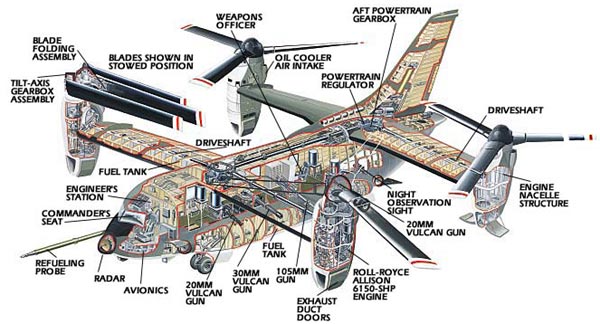
The team is also working on eight variations, or excursion designs, of the QTR that includes a sea basing variant.
A primary accomplishment in the last year for Bell-Boeing was the completion of the baseline aircraft and finishing seven of the eight excursion designs, Ewing added.
The nominal payloads span from 16 tons to 26 tons and the mission radius ranges from 210 nautical miles (nmi) to 500 nmi, he said.
Bell-Boeing is working under an 18-month, $3.4 million government funded effort to develop a QTR for JHL. The current effort ends in March '07, Ewing said.
Under the effort, everything that falls under the parameters of the fuselage belongs to Boeing. For example, avionics, crew cabin, crew station design and the landing gear. Bell is in charge of everything having to do with the wings, from engines to gear boxes, rotors, as well as total system integration, Ewing added.
The QTR's rear wings' size is determined by the clearance distance between the rotor diameter and the fuselage. There is 18 inches of clearance at the closest point, Ewing said. The rear wings are also set higher than the front wings to help minimize the effect from the front wing and rotor, he added.
 The overall length of the fuselage is set by a desire to keep a minimum of 36 inches of separation between the front to rear rotors, Ewing said.
On the baseline QTR, the proprotor has a 50-foot diameter compared to 38 feet on the V-22.
The baseline version also has an aerial refueling probe. The probe is fully retractable, Ewing noted. "We saved a couple of square feet in drag by making it retractable."
Fuel will be stored in both the forward and rear wings. However, the front wing fuel tanks will be filled first and then the rear tanks to balance out the aircraft. Ewing said.
The QTR also is being designed with an interconnect drive system. That will provide the ability to power one proprotor from any engine. Ewing said the system will add a bit more weight, but the capability it brings is worth it.
"If, for some reason, you had two engines inoperative on a single wing, you could pull one entire engine's worth of power [from] your operating wing," he said.
The size of the proprotors also drives the length of the cargo bay, he added. "We did not constrain ourselves in terms of the amount of cargo floor we put in. We used as much as possible. The JHL minimum requires 600 inches. The QTR baseline has 747 inches. It's a much more useful cargo box.
"Because we exceed that JHL requirement by 25 percent, we can get eight 463L pallets on the floor and an additional one on the [cargo] ramp," he said.
If Bell-Boeing limited the fuselage to 600 inches, Ewing said, the QTR would have then been limited to carrying only six 463L pallets.
The QTR can also carry up to 110 paratroopers and their equipment, but that is without a comfort station. Adding a comfort station would require removing six seats, Ewing noted.
The aircraft can also carry 150 passengers, he added.
One of the excursion designs calls for a larger QTR, what Ewing referred to as the "Big Boy." The floor width is expanded by 22 inches taking up to a total of 157 inches. The fuselage length is also increased from 747 inches to 815 inches to enable the QTR to carry one additional 463L pallet, he added.
The larger QTR is capable of carrying an armored Stryker vehicle or notional Future Combat System (FCS) vehicles with Non-Line-of-Sight Cannons, Ewing said. "Anything that normally doesn't fit into a C-130."
The "Big Boy" configuration adds another five feet to proprotors, taking them up to 55 feet in diameter, the largest Bell makes, Ewing noted.
While there is a requirement for a shipboard capable aircraft, there are challenges with that, Ewing said.
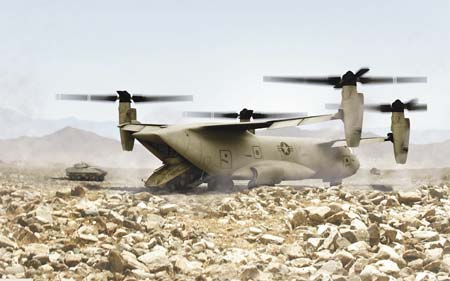
"It is still in the works. We have two concepts right now," Ewing said.
Once Bell-Boeing finishes the rest of the excursions, they will complete the sea base variant, he added.
"It will be a little problematic. We don't particularly care to fold this aircraft," Ewing explained.
The QTR does not have folding wings or rotors, he said. "It was not a requirement."
Even if Bell-Boeing designed the QTR rotors to fold, it still wouldn't fit on an aircraft carrier's elevators, Ewing said.
Bell-Boeing did a geometric layout of an aircraft carrier and both the LHD and LHA amphibious vessels. The study showed there was no gain by having the QTR live on board any of those ships, Ewing said.
One issue with the LHA is that because of the size of the QTR, the aircraft would not be able to taxi past the vessel's island, he added.
That limited the number of QTRs to two on a LHA. And Bell-Boeing recommended no more than three QTRs on a LHD, Ewing said.
Thursday, October 12, 2006
First movies shot in 1080p heading for Blu-ray, HD DVD

 From Tomshardware:
Hollywood (CA) - In time for the holiday shopping season, movies that were shot in high-definition format are heading for both next-generation DVD formats. The Da Vinci Code and Miami Vice will set the groundwork for a library of high-definition movies with a 1080p resolution (1920x1080 progressive).
On 14 November, Sony Pictures movie The Da Vinci Code will be released on DVD and Blu-ray. The Blu-ray format will take advantage of the fact that it was one of the first major movies to be shot entirely in 1080p. This means that, especially for those with 1080p HDTVs, the film's resolution will be optimal for the high-definition disc format.
While HD DVD and Blu-ray media offer a native 1080p resolution, all of the motives available today were not created in that resolution. However, since these movies weren't recorded in such a resolution, the up converting process makes educated guesses as to what would be in the additional pixels. With 1080p recording, every single pixel is recorded when the film is shot.
This transition is also happening with the other new high-definition format, HD DVD. Today, at Digital Life 2006 in New York, Universal Studios Home Entertainment announced that Miami Vice, the 2006 movies based on the 1970s TV show, which was also shot in true 1080p format, will be released on HD DVD on 5 December.
The movie will take advantage of one of HD DVD's unique features, which is the ability to have an HD DVD encoding on one side of the disc and a regular DVD on the other side. The HD DVD release of the movie will have the true 1080p format of the unrated version of the movie on the HD DVD side and the R-rated, standard definition resolution of the movie on the DVD side.
The transition to true, native 1080p movies is reminiscent of the transformation from analog to digital media. In the late 1980s and early 1990s, when audio cassettes were being replaced by CDs, it took a while for the complete and total transfer from analog to digital recording and editing. Now that virtually everything is digital, there are still paradigm leaps to take, such as the conversion of standard definition to high-definition.
Subscribe to:
Posts (Atom)


