When they're not impressing us with their HDTVs, Samsung's out making killer robots. Literally. Along with Korea University, they've created a robotic sentry that's equipped with two cameras (one infrared), zooming capabilities, and a BFG (a 5.5mm machine gun to be exact). The robot has the ability to differentiate between humans and inanimate objects and can even hunt its enemy from afar (which is actually kinda scary). It also has a speaker that beckons the fool that walks near it to surrender before being pulverized. The robot is damn good at keeping up with its "targets," but most of them seemed to be walking so we'd be curious to know if it's possible to out run the machine, though we wouldn't wanna be the guinea pig for that job.
Friday, November 03, 2006
Robot Century
From Gizmodo:

Now Net Neutrality Will Ban Ad-Based Network Business Models?
From Techdirt:
We've been dismayed at some of the really questionable or outright dishonest statements made by those paid by the telco industry on the issue of net neutrality. They keep distorting the debate -- which is disappointing, because there are reasonable arguments against net neutrality legislation. We just don't seem to hear them from the think tankers and the shills (sometimes, though not always, they're the same thing). The latest is a long piece by Haney Hance, who is certainly quite knowledgeable and experienced on the topic, but who writes up a long post explaining why enforcing net neutrality as a condition of the AT&T/BellSouth merger will make it that much more difficult for the US to have "world-class internet infrastructure." Amusingly, he points to the situations in South Korea and Japan as evidence of why the US needs better, cheaper broadband, failing to include the bit about how heavily state-supported both of these efforts were. Considering that he's warning about how it will stifle growth here to have the government involved, it's pretty bad to see him raise up those examples as reasons why we need less government regulation. He also says that AT&T/BellSouth wouldn't block web sites or degrade service, despite the fact that they've said they wanted to in the past. Hance, instead, says it's no problem since AT&T's CEO has promised he'd never do that (going against his own earlier statements). Of course, we've seen the telcos go back on their promises before -- so forgive us for being skeptical.
However, the meat of his piece is to suggest that if network neutrality rules were put in place, it would mean that telcos would be unable to experiment with business models that involved using advertising as a subsidy. Of course, he leaves out the part where he explains why this is. He just states it as true, when there's simply no evidence to support that being the case. A non-discrimination clause (while problematic in other ways), would not limit a telco from offering broadband service that's supported by advertising -- and there were even attempts (which failed miserably) to offer such services in the past. He even makes it sound like Google and Yahoo are somehow taking money out of the telcos hands by being able to advertise without having to give up a piece of it to the telcos ("content providers like Google, Yahoo and eBay get to keep every dollar spent on online advertising.") That's because those providers already pay the telcos for their bandwidth and provide the actual pages on which the advertisers advertise. What they do with it, is none of the telcos concern -- which is the point the network neutrality folks keep trying to get across. While I'm still worried about any new legislation that gives the government more power to regulate the internet, it's disturbing to see the continued batch of bad arguments coming out in favor of the telco position. It doesn't help their cause at all. It just makes it look like they don't have a real argument.
Why Not Have The Government Tax Google To Pay For Next Generation Networks?
From Techdirt:
For all of the bad arguments we see against network neutrality legislation, at the very least they come from a basic (if skewed) free market rationale. They very much focus on the idea of keeping the government out of the process (which is somewhat amusing when you consider how many favors, tax breaks, government-granted rights of ways and subsidies were used to get the telcos to where they are today). While it was AT&T's Ed Whitacre who kicked off the latest round of net neutrality debates a year ago by saying that companies like Google should pay AT&T for delivering their content, at least he was talking about a private deal between two companies. More recently, the telcos have backed away from the idea that Google owes them money for a free ride, perhaps because it's idiotically wrong and provably false. That's resulted in some net neutrality critics saying that the telcos would never, ever block a service like Google (despite their own earlier statements).
Apparently, however, someone forgot to tell all of that to Canadian cable company Videotron, who's chief stirred up the pot by not only suggesting that all of these internet companies are getting a free ride on his network, but tossing out all the "free market" "hands off" crap to come right out and say he thinks the government should put a "transmission tariff" on various internet service to help fund the ability for his company to build a new network. Somehow, I think Robert Depatie may have lost a bunch of support from free market think tankers on that suggestion. Of course, there is no fundamental reason for this, other than greed from a company who wants more money from the government because it's unable or simply too lazy to build up its own business. David Canton responds to this suggestion the same way some of us suggested Google should respond to the earlier suggestions that they were getting a free ride: they should ask the telcos to pay them. After all, it's services like Google and Apple and Amazon that make the broadband lines the telcos and cable companies provide valuable. The problem is that these telcos and cable companies think they have the power position here, when they don't. Or, perhaps, in this case, Videotron realizes it doesn't have the power position, which is why it's asking for the government to step in and force Google to pay up.
Thursday, November 02, 2006
Foose Hemisfear
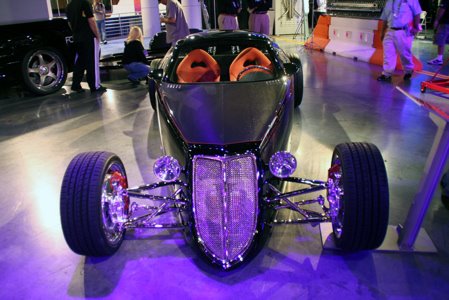
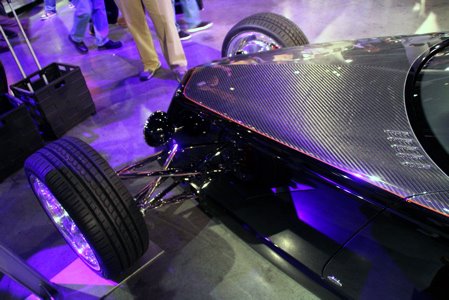
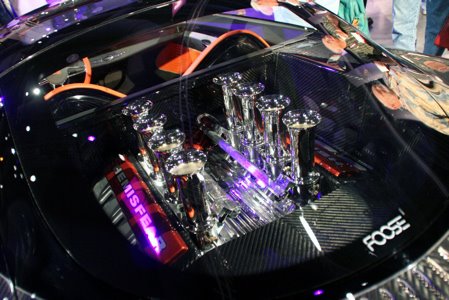
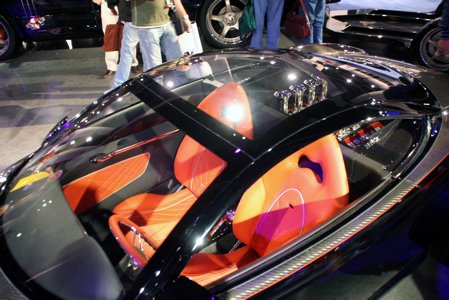
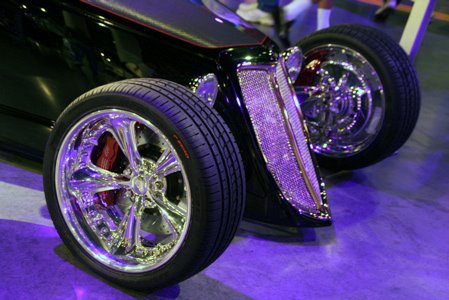
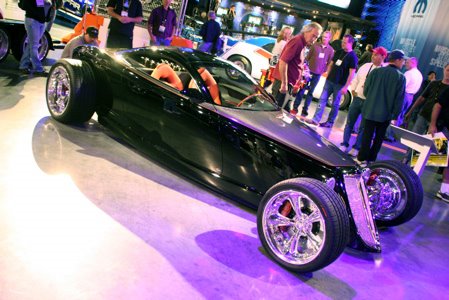
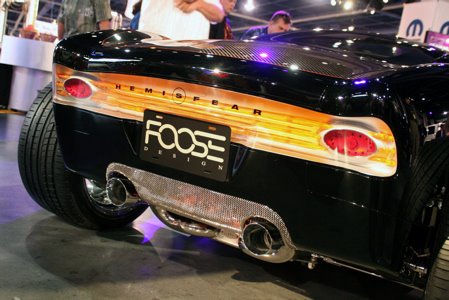

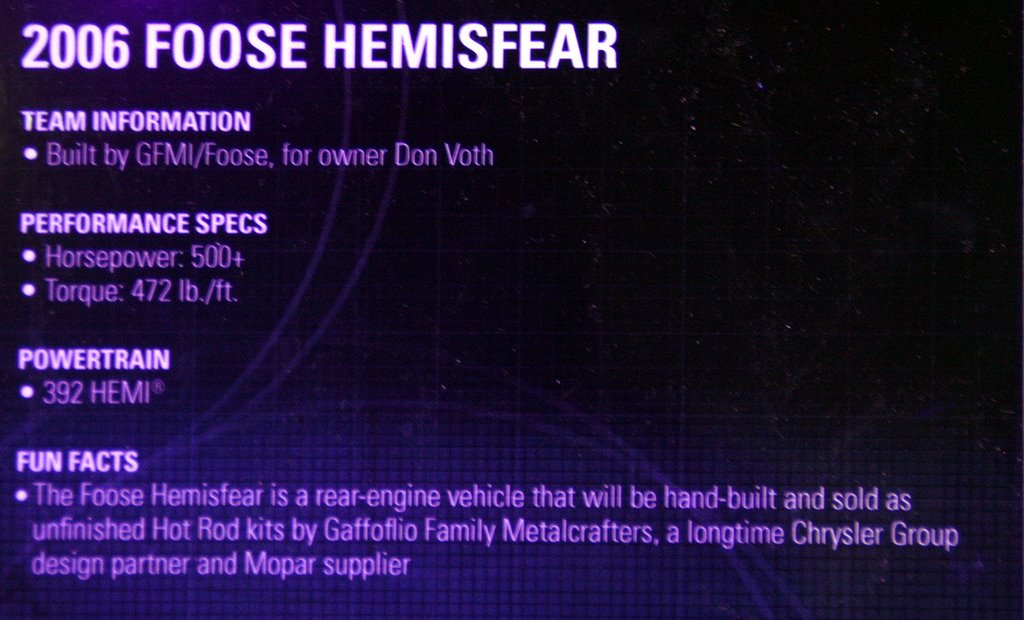 SEMA may have been overrun with sport compacts and speaker boxes years ago, but the hot rod still rules and the Foose Hemisfear found at the DaimlerChrysler display is one of the best we've seen this trip. It's a car that's captivating from every angle. From the exposed carbon fiber to the glass-top roof to the completely exposed steering and braking hardware that's polished brighter than your grandma's Sunday silver, the Hemisfear will not let you break eye-contact until you've inspected every inch of it. Eventually you'll find your way to the rear where Chrysler's new HEMI 392 crate motor resides amidship under the aforementioned glass top roof. The engine itself is a work of art, though its 500 horsepower and 472 ft-lbs. of torque are meant for more than just display. What's unusual about the Hemisfear compared to most of the other cars at SEMA is that you can actually buy it. It will be sold as unfinished kit from Gaffoglio Family Metalcrafters. In fact, this particular one is under private ownership.
Subscribe to:
Posts (Atom)


