Showing posts with label Aerodynamics. Show all posts

Monday, October 30, 2006

Boeing to Begin Ground Testing of X-48B Blended Wing Body Concept

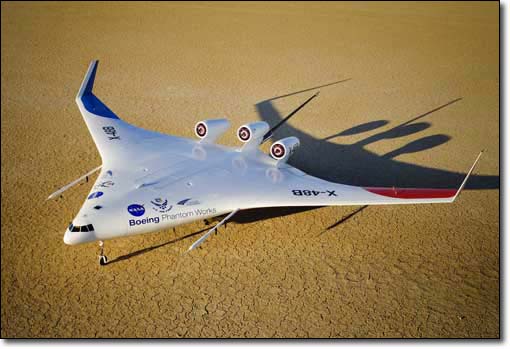
In cooperation with NASA and the U.S. Air Force Research Laboratory, Boeing Phantom Works will soon begin ground testing its X-48B Blended Wing Body concept in preparation for flight testing early in 2007. (Bob Ferguson photo)

EDWARDS, Calif., Oct. 27, 2006 -- In cooperation with NASA and the U.S. Air Force Research Laboratory, Boeing Phantom Works soon will begin ground testing of its X-48B Blended Wing Body (BWB) concept in preparation for flight testing early next year.

The X-48B ground and flight testing will take place at NASA's Dryden Flight Research Center at Edwards Air Force Base in California, where two high-fidelity 21-foot wingspan prototypes have been delivered.

The prototypes were produced to explore and validate the structural, aerodynamic and operational advantages of the BWB concept. They were designated the "X-48B" by the U.S. Air Force based on its interest in the design's potential as a future military aircraft.

"Earlier wind-tunnel testing and the upcoming flight testing are focused on learning more about the BWB's low-speed flight-control characteristics, especially during takeoffs and landings," said Norm Princen, Boeing Phantom Works chief engineer for the X-48B program. "Knowing how accurately our models predict these characteristics is an important step in the further development of this concept."

X-48B Ship 1 completed extensive wind tunnel testing at the Old Dominion University NASA Langley Full-Scale Tunnel this summer before being shipped to NASA Dryden as a backup to Ship 2, which will be used for flight testing early next year.

In preparation for first flight, the X-48B Ship 2 will undergo ground testing to validate its engine- and fuel-system integrity, battery endurance, telemetry link communication, flight-control software, and low- and high-speed taxiing characteristics.

The X-48B's three turbojet engines will allow the 500-pound, composite-skinned, 21-foot wingspan prototype to fly up to 120 knots and 10,000 feet in altitude during flight testing.

The X-48B research project is led by Phantom Works, Boeing's advanced R&D unit chartered to provide innovative technology and system solutions to meet future aerospace needs. Cranfield Aerospace, Ltd., in the United Kingdom built the two X-48B prototypes for Phantom Works in accordance with Boeing requirements and specifications. NASA's participation in the project is focused on fundamental, edge-of-the-envelope flight dynamics and structural concepts of the BWB, while AFRL is focused on the BWB's potential as a flexible, long-range, high-capacity military aircraft.

Thursday, October 12, 2006

Water tunnel shows smooth water leads to smooth flying

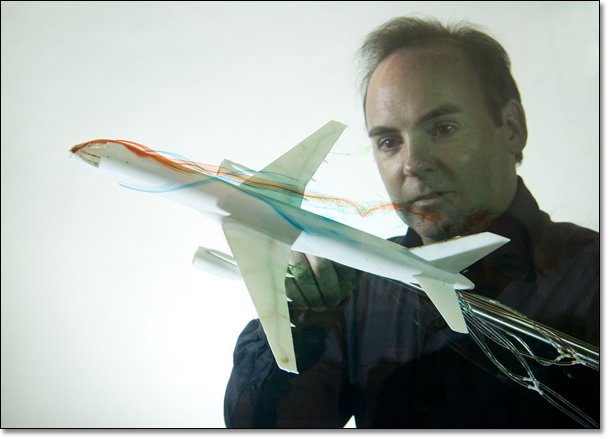
Dye-colored water reveals flow patterns around a Boeing 757 model as Aerodynamicist Pat Hayes examines flow fields from outside a water tunnel in Huntington Beach, Calif. The 757 model is being used to calibrate water tunnel instruments because of the model’s large existing database of dynamic flight characteristics. Flow visualization in the water tunnel provides detailed observation of the flow around a wide variety of configurations. The process uses a number of techniques, including dye flow through ports in the model, hydrogen bubble generation from strategic locations on the model, or laser light sheet illumination. The free-stream flow and the flow field dynamics are low speed, allowing real-time visual assessment of the flow patterns. (Anthony Romero photo)

By Bob Howard

Water tunnels have been used in one form or another to explore fluid mechanics and aerodynamic phenomena since the days of Leonardo da Vinci. Only in recent years, however, have water tunnels been recognized as highly useful facilities for critical evaluation of complex flow fields on modern vehicles, such as high-performance aircraft.

The water tunnel in Huntington Beach, Calif., is a one-of-a-kind test facility at Boeing. With movement like the slow, slow waters of a deep river, the tunnel produces a nearly perfect, undisturbed flowing column of water by taking out all flow distortions, currents and eddies before sending it through the glass tunnel.

Measuring 10 feet by 3 feet by 4 feet high (3 meters by 0.9 meters by 1.2 meters), the tunnel has been newly outfitted with sophisticated software and a sensitive, mechanical apparatus that aeronautical designers call a “force and moment balance” -- a device that essentially resembles a stick, but with miniature instruments inside. The apparatus holds the model, points it into the water flow and moves it to any flight orientation desired -- even upside down. Its sensors continuously read and record dynamic data of the physical forces the vehicle experiences every moment of the simulated flight.

The tunnel is now completing calibration tests and coming on line to test the next generation of air transports, fighters and X- vehicles, providing engineers with quick, low-cost assessments early in the design process and help them build a database of dynamic measurements.

“We will be helping our customers achieve higher quality earlier in the design cycle,” said Aerodynamicist Pat Hayes. “A quick check of the design early on greatly reduces risk, because issues are discovered and solved sooner when they are easier and less costly to address.”

Water tunnels are highly useful for seeing and evaluating complex flow fields dominated by vortices and vortex interactions. The free-stream water flow patterns created by a model’s particular design are made visible using dye flowed out through ports in the model itself.

The water tunnel is usable with a minimum of training, and its location enables engineers supporting proprietary and classified work to use it as well.

With a rapid check of the design, and with the dynamic data produced from simulated flight, the airframe designers are able to bring in the next team months earlier with high confidence they are on the right track. Guidance navigation and control designers can come on board with assurance that an early design is at a mature point for them to start. And, of course, the sooner they can get in the game the better.

“What could cost six months in effort at a vendor -- not to mention a very expensive model -- can be handled in Huntington Beach in one week using the Stereo Lithography Labs to build the model and the water tunnel for dynamic data testing,” Hayes said.