Tuesday, October 10, 2006

Samsung Launches 10-Megapixel Camera Phone

Samsung today launched the SCH-B600 in the Korean market, world's first 10-megapixel mobile phone.

Samsung's 10-megapixel camera phone is 6 mm thinner and 10 g lighter than the 7-megapixel camera phone (SCH-V770) and sets itself apart from its previous megapixel camera phones by combining mobile TV capability in Satellite standard.

The B600 offers the same level of picture-taking sophistication that a 10-megapixel digital camera offers including functions such as 3x optical zoom and 5x digital zoom. Also fitted with a LED autofocus feature which assists users to capture clear, crisp photos even in dark settings, the B600's LED autofocus automatically determines the distance and utilizes the appropriate focus setting for optimal photo shooting. The B600 also supports white balance, manual focus, continuous picture-taking, and interval picture-taking functions.

It also supports Bluetooth which enables users to send pictures wirelessly to other mobile phones, printers or to Bluetooth headsets.

The high-color reproduction TFT-LCD produces the highest possible display for its size. The photo-fine chromic LCD can reproduce 16 million colors, virtually any color found in nature, earning it the "True Color" appellation. Moving pictures can be recorded in QVGA resolution at 15-30 frames per second. Users can watch live TV in crisp picture through Satellite DMB function.

It also supports external memory (MMCmicro) in addition to its internal memory. The mobile phone supports a TV-out function where users can connect their phones to view still or motion pictures.

The B600 comes with a design reminiscent of a real digital camera. The front is designed as a bar-type mobile phone, while the back side is used as the digital camera.

Other advanced functions in the B600 include an MP3 player, business card reader, and 128 polyphonic sounds.

The price of B600 is around 900,000 won (about $900) in Korea.

Samsung SCH-B600 Specifications

- Standard: CDMA 2000 1X EVDO (800 MHz)
- Camera: 10-Megapixel Camera
- Display 2.2-inch 240 x 320 px 16 million color TFT LCD
- Features: Mobile TV (Satellite Digital Multimedia Broadcasting)
- Video Recording & Messaging (MPEG4 / H.264)
- MP3/ AAC / AAC+
- Dual Speaker / Anycall Band
- Bluetooth Technology / PictBridge / Voice Recognition
- Document Viewer / TV-output / BT Printing
- Memory: External memory (MMCmicro)

Teen Plays Videogame With Brain Signals

"A team of ECoG (ElectroCorticography) researchers from Washington University in St. Louis successfully wired a young man's brain up to a computer and began reading the neurological firings in his brain. After analyzing the action potentials created when a neuron fires, they were able to get two-dimensional control of a cursor. Taking the research one step further, they decided to connect an old Atari 2600 to the signal processing computer to see if the young man could control the videogame system."

Golen Years of Internet Video are over

By now, everyone knows that Google has bought Youtube. This is the end of the Golden Years of video on the internet.
I didn't think it would happen, but it did: Google has agreed to buy YouTube for $1.65 billion in stock. The news comes after a cornucopia of press releases announcing Google and YouTube deals to distribute music videos from Universal, Sony, Warner Music, and CBS, paving the way for a relatively risk-free buyout from Google's perspective.
When Google bought Youtube they made deals with Universal, Sony, Warner Music, and CBS. That means that the copyright issues with video have been resolved. But what this means is the end of what was the great thing about Youtube. You can see clips from TV studios and watch music videos made by other people. But with Google going legit, all this will go away. Now we will see more Ads, more of the same stuff that is on TV and less of the focused/edited "meat and potatoes" content that can be found on the original Youtube which people went for in the first place. Now it will be the same "fluff" crap that is on TV.

Monday, October 09, 2006

First true hybrid manned/unmanned aircraft A/MH-6X helicopter takes to air

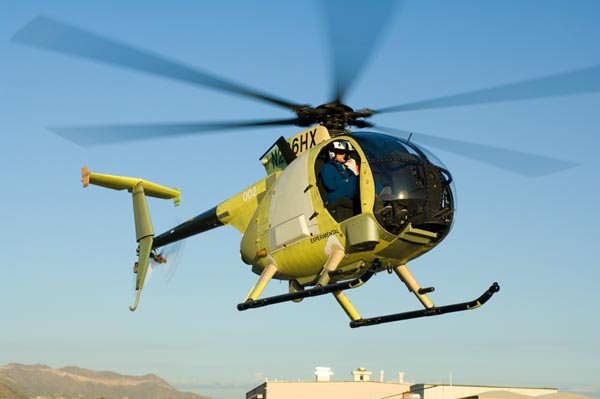
The newly designed A/MH-6X light-turbine helicopter has flown for the first time¸ marking a significant milestone in the continuing development of the versatile manned/unmanned military aircraft.

The newly designed A/MH-6X light-turbine helicopter has flown for the first time, marking a significant milestone in the continuing development of the versatile manned/unmanned military aircraft. The aircraft combines the proven performance of the A/MH-6M Mission Enhanced Little Bird (MELB) with the unmanned aerial vehicle technologies of the Unmanned Little Bird (ULB) Demonstrator, a modified MD 530F civil helicopter that has been in development since 2004.

“The A/MH-6X is the first true hybrid manned/unmanned aircraft, adding another mission capability to the combat-proven, multi-mission MELB helicopter,” said Dino Cerchie, Advanced Rotorcraft Systems Unmanned Little Bird program manager. “The A/MH-6X Little Bird offers exciting new possibilities for an already outstanding platform.”

The A/MH-6X lifted off Sept. 20 at the Boeing Rotorcraft Systems facility in Mesa, Ariz., and flew as a piloted aircraft for approximately 14 minutes before landing safely. Following the flight, Boeing test pilot Todd Brown reported, “The aircraft flew great. It is very responsive and delivers outstanding performance.”

Future testing will expand the manned and unmanned envelopes. Aircraft performance will be similar to the ULB Demonstrator with an additional 1,000 pounds of payload that can be used for increased range, endurance or mission hardware. Total payload for the ULB Demonstrator is greater than 2,400 pounds.

Boeing designed and developed the derivative helicopter for both military and civilian applications, including Homeland Defense. The helicopter’s external appearance and mechanical systems are similar to the operational A/MH-6M helicopter flown by the U.S. Army’s 160th Special Operations Aviation Regiment.

Boeing made the most significant modifications to the cockpit avionics and electrical systems. The A/MH-6X aircraft has a prototype “glass” cockpit that provides system redundancy and additional technologies in digital maps and data fusion. It also has many network-centric features like Ku-band communication, digital radios, Internet Protocol-addressable aircraft systems and on-board, high bandwidth data processing and storage.

“The unmanned hardware and capability developed in this program can be installed in any helicopter,” said Cerchie. “The A/MH-6X Little Bird aircraft provides exceptional performance, capability and reliability for manned or unmanned missions in a compact, highly transportable aircraft that can leverage many existing qualified aircraft systems.

“The demonstrator, which first flew just over two years ago, has logged nearly 500 manned and unmanned flight hours,” he added. “The first flight of this much more capable A/MH-6X was a logical extension of an outstanding developmental program. The team has made it look easy, but it has taken a lot of hard work by some very dedicated folks.”

Boeing is preparing the manned/unmanned aircraft variant for domestic and international markets. “The desire and need for an all-purpose compact workhorse is there, whether it’s manned or unmanned,” Cerchie added. “This aircraft is the low cost solution for urban or confined operational areas, where full mission capability and connectivity are required.”

Sunday, October 08, 2006

A 3D system for safer flights

Pilots learn to fly by looking out of the window, but what happens when the window is surrounded by fog or a sandstorm? They rely on computers to guide them, of course. But the navigation systems most pilots use today leave something to be desired.

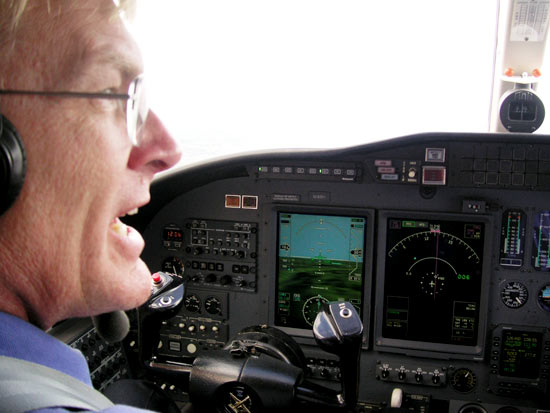
Manufacturing giant Honeywell has developed a new safety system to show the pilot where the plane is in the sky when visibility is low and, more importantly, whether it's about to crash into anything. Silicon.com recently got to see the new system in action on a test flight in a private plane.
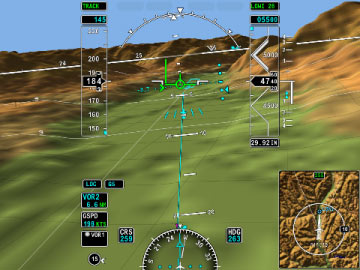
The black screen on the right shows the Remote Access Aviation System (RAAS) pilots currently use to fly in low-visibility conditions. It provides a 2D representation of the area surrounding the plane and, using a terrain database, alerts the pilot if the plane is too close to the ground or any obstacles. On the left is Honeywell's new 3D system, the Synthetic Vision System (SVS).

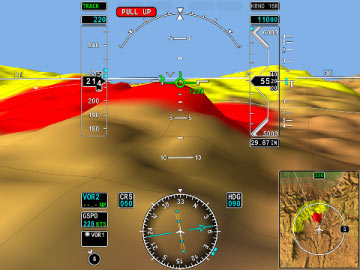
If the plane gets too close to the ground, or an obstacle appears, the landscape turns red, signaling imminent danger. This is akin to RAAS, which uses red and an audio alert sound to signal danger. You can see a color representation of the old system in the lower right-hand corner of the image here. SVS is not designed to replace the existing 2D system but to assist pilots when flying in zero-visibility conditions.
The runway was clearly visible as the plane touched down--the SVS is shown here running on a PC for our trial flight, though ultimately it will be integrated into the plane's computer systems. After initial skepticism, pilots who have tested the SVS are embracing the new technology and questioning how they ever survived without it, a Honeywell engineer said.

Gulfstream is the first airline to adopt SVS, and the product will be installed on its newest G450 aircraft in 2007. Upcoming features include the ability to display other nearby aircraft on the screen to prevent midair collisions--but that will have to wait on a mandate from the aviation industry to install GPS on every plane.